2007-04-01 Guy Debord and NDA
It's not a secret (oops sorry for the bad joke) that I don't like the principle behind the non-disclosure agreement. The idea behind a non-disclosure agreement is the old approach of "secrecy" in our societies. Everyday, we meet software/hardware companies trying to force people to sign non-disclosure agreements for some useful (and not always…) technical information (e.g. how to access a badly design wireless chipset). Everyone knows that Free Software is somehow due to a non-disclosure agreement proposed to Richard Stallman by Xerox for a simple printer driver. I had always the issue on how to explain clearly the "secrecy" concept behind non-disclosure agreement but today, I found the following explanation from Guy Debord. The text below is just from the commentary of his well-known book : Society of the Spectacle that has nothing to do with non-disclosure agreement. He talks about the role of "secrecy" in our societies and clearly explain at the same time the modus-operandi of a non-disclosure agreement :
... Elles (les brides d'information que l'on offre à ces familiers de la tyrannie mensongère) font plaisir pourtant à ceux qui y accèdent, car ils se sentent supérieurs à tous ceux qui ne savent rien. Elles ne valent du reste que pour faire mieux approuver la domination, et jamais pour la comprendre effectivement. ...
from page 85 of Commentaires sur La société du spectacle by Guy Debord
Tags: freedom copyright nda freesoftware secret
2007-04-07 GeoRSS Simplicity
When I saw the GeoRSS standard integrating GML or Geo Simple, I was impressed by the simplicity behind the concept. How it works ? You have a simple namespace for GML or Simple that you just need to add in your feed (atom or RSS). That's it after you are ready to point, line, box or polygon your location for an item or in a channel. I made a quick patch and geo module for my Oddmuse installation. The nice part is a lot of web services (like Google Maps) is supporting RSS with geo information. That means you can browse my blog by location… that's just another way to represent and classify information. I'm pretty sure that the use of GeoRSS will grow… and unpredicted services will pop up between the virtual and the physical world.
Tags: blog geo oddmuse freesoftware georss
2007-04-10 HackLu 2007 Call for Paper and Security Conference
 I'm a big fan of full disclosure regarding security vulnerabilities discovered in software or in hardware. The meaning behind full disclosure is often different following with who you are talking about. Of course, responsible disclosure is often a good thing to give the time to the hardware/software vendor or software author to fix the problem before publishing the vulnerability. The process of full disclosure should help to build better software or, at least, reduce the risks associated to a published vulnerability. But the process only works if the two parties are playing fair : the discoverer (the one who discovers the vulnerability) and the author (the one who wrote the vulnerable software/hardware). Please keep mind in the software world that the discoverer of a vulnerability can become the one who is writing vulnerable software. So humility is a keyword in the process of full/responsible security disclosure. In such case, the two parties should talk together and provide as much information as possible to solve the vulnerability. It would be nice if more and more security advisory include by default the process of solving the security issue too. Not only the vulnerability itself but the whole information how the vulnerability was introduced, how it was (could be) solved and the scope of the resolution. I just make this comment because that could be an interesting paper/presentation to submit for the hack.lu 2007 conference taking place in Luxembourg in October 2007. The post is a kind of advertisement for the current call for paper and call for poster. Disclaimer : I'm involved in the conference ;-)
Tags: security conference luxembourg security_conference disclosure
2007-04-11 Tasty Local Food
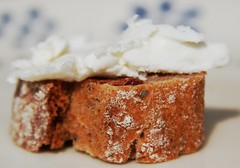
Sometimes, it could be difficult to find good local food but we are quite lucky. There is a nice local market every Friday in Ansart (not far away from Les Bulles). There are lot of nice products from the producer to the consumer. Just to say that is not impossible to eat local tasty food… On the photo, you can see some goat's milk from Flassigny and bread from Avioth.
2007-04-15 Where Google Finance Is Getting The Data
Looking at GooDiff today change set, there is a simple change for finance.google.com in their FAQ :
 ** How much historical data does Google Finance have? **
...
+ Historical data and daily updates are provided by [ CSI ](http://www.csidata.com./) .
We had a discussion some months where finance.google.com is getting their financial information. But Google is simply using CSI Data Inc. (the provider for all non real time trading information) like any other web-based finance information. When asking the question, we were just distracted by the interface and the representation/presentation of information… but at the end it's the just plain standard data. At the end, the source of information is important but not really the differentiator among the other web based provider : the differentiator is representation of the information. If Google succeeds in getting real time data for NYSE as they asked SEC that the NYSE (and its subsidiary company managing the trading information) to follow the free data policy. This could be a great success as the value of real time information is more important in the eyes of the user. The competition should clearly focus on the representation/presentation of the information because if the free data policy is applied for financial information, the difference won't be source but just how we see the information on the screen.
Tags: google goodiff trading finance information free_information nyse
geo: Les Bulles, Chiny in the sunny garden.
2007-04-22 Founders Copyright
Founders' Copyright : not easy ?
In April 2003, Creative Commons announced a new project called Founders' Copyright : the idea behind is to propose authors to have a limited monopoly (14 years) on their work instead of the 70 years after the author's death. The idea is to free up work after their period of profitability for the author and the editor. For my perspective, it's a good idea and show the commitment of the author for respecting the social contract between the society and him. Back to the origin of copyright/authors' rights , it was one1 of the purpose of having the right balance between the authors and the civil society. Going back to the project at Creative Commons in 2003, O'Reilly media was planning to release a lot of out-of-print books :
O’Reilly, the first Founders’ Copyright adopter, will release 157 out-of-print volumes under a Creative Commons attribution license and 394 in-print titles under a Founders’ Copyright arrangement, pending author approval. The Creative Commons website will list the books in question and announce their availability as their Founders’ Copyright terms lapse.
But it looks very difficult, looking at the O'Reilly Open Book web site we are far away from 157 books in early 2007. Some out-of-print are also cleared on the creative commons website meaning the author gave is permission but the book is not available on the Open Book web site (e.g. : Net Law: How Lawyers Use the Internet). Now I'm wondering where are the difficulties ?
- Asking the Author to "public domain" his work ? (When you have multiple authors for the same work, you must ask all of them and if one is dead you must ask the successor…)
- To convert and make the content available ? (I'm pretty sure that some editors are still using proprietary format to store their publication)
- To separate the public domain work from the Author from other copyrighted work ? (example you have diagrams or pictures made by others)
There are some more difficulties to public domain a published or unpublished work. What are the major issues ? I would tend to say "asking the author(s)" and waiting for their official written answer. The rest is time consuming but not impossible to achieve. If you have more information, feel free to contact me (by the way I changed my email to the single character a followed by my domain name in Belgium).
Tags: oreilly creativecommons copyright editors book publicdomain archiving
2007-04-28 Electronic Music Discoveries
I received my latest order from the excellent Alfa Matrix label. In the pack, there was Deliberately Fragile (double CD including the remixes) from Technoir. Technoir, beside the name of the bar in the Terminator movie, is the name of a German duo doing a nice kind of dark (and sometimes pop) electronic music. The voice of Julia Beyer is really great and giving a nice and deep atmosphere to the majority of the tracks. The remixed version are adding some complexity to some of the song. A must to acquire if you like electronic music.
Another nice discovery is checkpoint 303, the concept behind the band is really interesting. They are taking samples in the occupied territories (the Palestinian territory) and make electronic music out of it. The work is not only politic but they really create new spaces by mixing the samples with atmospheric music. The songs are available under a restrictive creative common license (yes, not the CC-SA license). But the music is interesting and accessible. Maybe a new way to introduce the issue of the occupied territories to student in secondary school ?
Tags: blog music ebm paslestine electronicmusic technoir checkpoint303
![[FSF
Associate Member]](http://www.foo.be/fsfbutton-adulau.png)

