2007-06-03 What's Make A Good Web 2.0 Application
Sometimes people ask me why I choose a specific web application for a service than an other available for free. I was unable to find a consistent answer to that. Looking more to the Web 2.0 (you are free to remove the version as I think it's applicable to any web application) services I frequently use gave me some possible tracks/ideas what's a good web service. I tried a lot of web services the past years but I only kept to work with the following :
- flickr - my flickr account
- del.icio.us - my del.icio.us account
- LibraryThing - my librarything account
- hiveminder - quite new compared to the others
All the web services listed here have different usage and they cover a large scope of use. But I choose them for some common reasons :
- The ability to extract and backup your data entered (or more) from the web services. For me, it's the minimal requirements for a web service, if you push information to them you want to get it back. For example, LibraryThing is giving you back more information. For any ISBN you entered, you can get back the complete information about the book. For you (as a user), the cost of entering information is low (just an ISBN) but you can get back more (a full CSV file of your library). A good deal for the user and not only for the web service provider.
- A collateral point is the support of feed format export (like RSS/RDF, Atom or OPML). To import your data in your own and private application. That's well supported by the 4 web services listed. For example in flickr, the ability to get an RSS feed of the photos per group is nice for building topic oriented application (e.g. a slideshow mixing the tagging from another service). I'm sure that more will come with the increasing use of information feeds.
- A simple and clean interface. A lot of the web services I used improved their situation about usability (I think the term is covering more than just the efficiency of a web service) but it takes time to reach simple interface. Hiveminder is very new compared to the others and its weak point is sometimes the usability. I'm pretty sure that will improve knowing the work done on RT by the same team.
- Gaining from sharing. The social aspect of the new web services is critical. flickr, del.icio.us and LibraryThing is providing a nice gain compared to private software use only. I discovered books with LibraryThing, interesting links from del.icio.us or relevant pictures from flickr. By giving some information, you get more information. I think it's vital for any new web service. and sometimes, you can share more with your closed friends.
- A clean and consistent user and privacy policy. It's sometimes hard to find information in the legal labyrinth. It's still the major weak point of web services. What are you really doing with the information given ?
I don't know if it really helps when evaluating web services but it's often a starting. If a web services is seriously lacking one of the mentioned points, I tend to discard it in the short term. Of course, this is only my limited perception of web services.
Tags: usability internet eula legal complexity policies flickr del.icio.us librarything hiveminder internet social innovation
2007-06-09 Ranked Bibliography
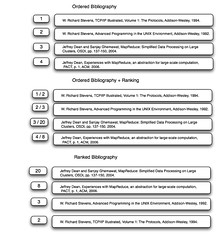
Last days were busy but I found the time to finish the reading of the Myths of Innovation written by Scott Berkun. It's a great book about innovation and its long process. The book is very interesting but I was positively surprised by his ranking method for his bibliography. Instead of having an "order of appearance" for the references in its book. He used a ranking method : he adds one point to the reference when using it. Like that, the bibliography is ordered by relevance. Nice and clever idea. The funny part is for his own previous book listed but ranked with zero. Maybe it's time to have a distributed ranking system for the bibliography ? a web service where people can add one point when they use a book or a paper as a reference. It's a small innovation but I'm pretty sure it will be more and more used.
Update : Jean-Etienne gave me another nice mixed example (ordered and ranked) of bibliography from the scientific community. As I was wondering what's the most efficient way, I made a small example from a small subset of a bibliography. Just click on the image to compare and see how the meaning of the bibliography can be affected by the simple fact of ordering or ranking.
Tags: social innovation bibliography ranking information_representation
2007-06-24 Art Is Always Better

Tags: art violence non-violence censorship freedom
![[FSF
Associate Member]](http://www.foo.be/fsfbutton-adulau.png)

