2008-11-02 We Enter The Age Of Cyberpunk
That's a "great day", we just enter into the age of Cyberpunk by the recent vote of the French Senate :
The French Senate has overwhelmingly voted in favour of a law that would cut off access to the internet to web surfers who repeatedly download copyrighted music, films or video games without paying.
In other words, the "corporate elite" (or the old and aging musical industry) made a law to cut access to Internet while there are (sometimes, just suspicious or without consent of the Internet user) downloads of "copyrighted content". Hmmm… this looks very close to the story line often used in different cyberpunk stories. To be more precise here is the portrait of cyberpunk societies made by David Brin :
…a closer look at cyberpunk authors reveals that they nearly always portray future societies in which governments have become wimpy and pathetic …Popular science fiction tales by Gibson, Williams, Cadigan and others ''do'' depict Orwellian accumulations of power in the next century, but nearly always clutched in the secretive hands of a wealthy or corporate elite.
We have to be prepared and should start the business to make a "black market" for internet access where all those people excluded from official access can get back access to the network.
2008-11-08 Copyleft Licenses and Activating The Perpetual Loop
When I first touched free software (that was a long time ago.. I'm feeling old Today) that was mainly for a technical reason. The technical reason quickly shifted to the ethical implication of free software and its relation with freedom in general. The comfort of copyleft licensing is a like a promise to me : "keeping "information" eternally free". My view is that copylefted information (from free software to free art) is just like a biotope where the environmental condition (in this case copyleft licensing) helps to create a living place. The copyleft is a guarantee for the biotope to have a sufficient input to grow and to provide a good fertilizer. In the past few years, the ecological system of copyleft has been working quite well but the main reason (IMHO) for its limited grow is the incompatibility between the copyleft-type licensing as those licenses are often mutually exclusive.
I'm not in favor of the excessive proliferation of copyleft-type license increasing the legal complexity while not improving the life activity in the copyleft biotope. That's why I'm using the following licensing statement :
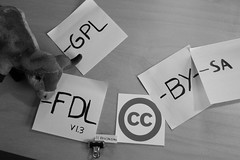
This work is licensed to you under at least version 2 of the GNU General Public License. Alternatively, you may choose to receive this work under any other license that grants the right to use, copy, modify, and/or distribute the work, as long as that license imposes the restriction that derivative works have to grant the same rights and impose the same restriction. For example, you may choose to receive this work under the GNU Free Documentation License, the CreativeCommons ShareAlike License, the XEmacs manual license, or similar free licenses.
The recent minor extension of the GNU Free Documentation License 1.3 is creating the ability to also use the Creative Commons Share Alike (CC-SA) is going into the direction to improve the biotope interaction. In my view, I never understood why we have different copyleft licenses for at the end any information works like computer programs, images, arts or documentation living in the same biotope. I was willing to use the GNU General Public License for any type of free information works. I'm sure that differences between the type of works will disappear in the future and at the end, we'll have a generic GNU GPL (version 4?) where any copylefted works are included. Life is so beautiful in this biotope that we cannot limit it with incompatible licenses…
2008-11-16 It s Time To Join APRIL
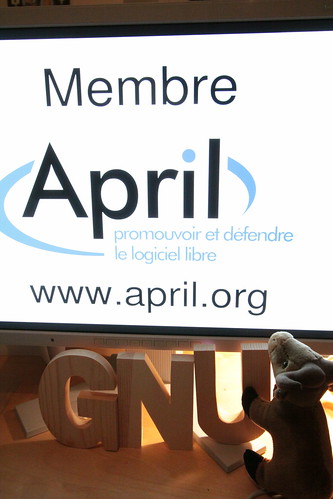
It's time to join APRIL, the GNU will thank you.
It's time to join APRIL… If you have an organization to join in France doing the promotion of free software and its philosophy. There is only one… this is APRIL. The GNU will thank you (as you can see on the picture, he is already thanking me of being a member, even if I'm from Belgium).
Tags : gnu freedom april freesoftware free_software
![[FSF
Associate Member]](http://www.foo.be/fsfbutton-adulau.png)

