2008-06-15 Internet Liberties Still In Danger
Everything started when government tried to limit the liberties on Internet, the first major case was the Communications Decency Act. The famous blue ribbon campaign of the EFF started due to that legal non-sense in 1996. We thought that we were safe from such stupid regulation in the cyberspace when the US supreme court admitted that the Communications Decency Act was mainly unconstitutional. But the history proven the opposite, governments are continuously trying to limit civil liberties on Internet (and not only in China). It's a fact and seeing such intensity from government to limit our rights in a space where freedom is there by nature, I really have a confirmation (by repeating so many times so many legal trick to achieve a complete on control on Internet) that's an intended purpose to limit our freedom space.
Hopefully there are still an active (from scientific to citizen) community where interesting paper came such as : Cassell, Justine, and Meg Cramer. “High Tech or High Risk: Moral Panics about Girls Online." Digital Youth, Innovation, and the Unexpected. An interesting part is the comparison with telegraph and telephone. The conclusion of the paper also showed the danger of the "moral panic" for women :
And in each case that we have examined, from the telegraph to today, the result of the
moral panic has been a restriction on girls’ use of technology. As we have described above,
the telegraph, the telephone, and then the internet were all touted for how easy they were for
young women to use, and how appropriate it was for young women to use them. Ineluctably,
in each case, that ease of use and appropriateness became forgotten in a panic about how
inappropriate the young women’s use of these technologies was, and how dangerous the
women’s use was to the societal order as a whole.
In the current case, the panic over girls’ use of technology has taken the form of believing
in an increased presence of child predators online. But, as we have shown, there has been
no such increase in predatory behavior; on the contrary, the number of young women who
have been preyed on by strangers has decreased, both in the online and offline worlds.

Finally, as with uses of communication technologies by women in the past, it is clear
that participation in social networking sites can fulfill some key developmental imperatives
for young women, such as forming their own social networks outside of the family, and
exploring alternate identities. Girls in particular may thrive online where they may be more
likely to rise to positions of authority than in the physical world, more likely to be able
to explore alternate identities without the dangers associated with venturing outside of their
homes alone, more likely to be able to safely explore their budding sexuality, and more likely
to openly demonstrate technological prowess, without the social dangers associated with the
term “geek.” And yet, when moral panics about potential predators take up all the available
airtime, the importance of the online world for girls is likely to be obscured, as are other
inequalities equally important to contemplate.
But obviously, I'm still very affected by the continuous flow of bad law (like the recent one from France) or action like blocking Usenet. Do they want to turn Internet into an useless medium where free speech is banned ? and an Internet where so many technical restriction implemented, it becomes impossible to use it.

2008-06-23 Hardware Random Number Generator Useful
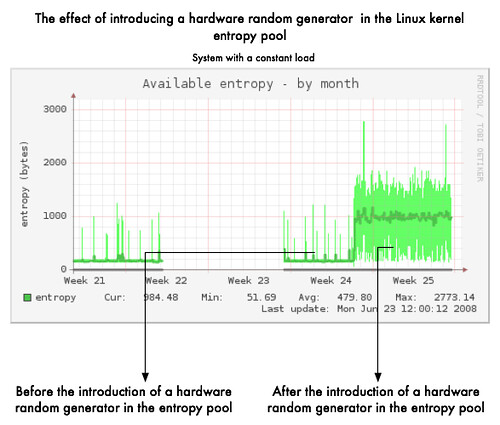
If you have a system machine generating various cryptographic keys, you really need a non predictable state in your entropy pool. To reach a satisfied level of unpredictability, the Linux kernel gathers environmental information in order to feed this famous entropy pool. Of course gathering enough unpredictable information from a deterministic system, it's not a trivial task.
In such condition having an independent random source is very useful to improve unpredictability of the random pool by feeding it continuously. That's also avoid to have your favourite cryptographic software stopping because lacking of entropy (it's often better to stop than generating guessable keys). In the graph below you can clearly see the improvement of the entropy availability. On an idle system, it is difficult for the kernel random generator to gather noise environment as the system is going in a deterministic way while doing "near" nothing. Here the hardware-based random generator is feeding regularly the entropy pool (starting end of Week 24) independently of the system load/use.
If you are the lucky owner of a decent Intel motherboard, you should have the famous Intel FWH 82802AB/AC including a hardware random generator (based on thermal noise). You can use tool like rngd to feed in secure way the Linux kernel entropy pool. In a secure way, I mean really feeding the pool with "unpredictable" data by continuously testing the data with the existing FIPS tests.
That's the bright side of life but I would close this quick post with something from the FAQ from OpenSSL :
1. Why do I get a "PRNG not seeded" error message?
... [some confusing information]
All OpenSSL versions try to use /dev/urandom by default;
starting with version 0.9.7, OpenSSL also tries /dev/random
if /dev/urandom is not available.
... [more confusing information]
If I understood the FAQ, by default OpenSSL is using /dev/urandom and not /dev/random first? If your entropy pool is empty or your hardware random generator is not active, OpenSSL will use the unlimited /dev/urandom version and could use information that could be predictable. Something to remember if your software is still relying on OpenSSL.
Update on 03/08/2008 :
Following a comment on news.ycombinator.com, I tend to agree with him that my statement "/dev/urandom is predictable" is wrong but that was a shortcut to urge people to use their hardware random generator. But for key generation (OpenSSL is often used for that purpose), the authors of the random generator (as stated in section "Exported interfaces —- output") also recommend to use /dev/random (and not urandom) when high randomness is required.
That's true when you are running out of entropy, you are only depending of the SHA algorithm strength but if you are continuously feeding the one-way hashing function with a "regular pattern" (another shortcut). You could start to find problem like the one in the linear congruential generator when the seed is one character… But that's true the SHA algorithm is still pretty secure. So why taking an additional (additional because maybe the hardware random generator is already broken ;-) risk to use /dev/urandom if you have already a high-speed hardware random generator that could feed nicely /dev/random?
![[FSF
Associate Member]](http://www.foo.be/fsfbutton-adulau.png)

