2008-05-02 Linkfingerprint MachineTag
In my continuous MachineTag dementia (but at least useful with the license Machine Tag), I experimented an implementation of an interesting expired Internet-Draft called Link Fingerprints into MachineTag. The idea of the Link Fingerprints is to fingerprint the information reference to be sure that the content of the retrieved object is matching the initially reference object (you can replace object by file). In other words, to be sure that the file downloaded is the one initially provided by the author. This is very handy when distributing free software over Internet to limit the risks of downloading compromised software. The background idea of Link Fingerprints is really good but implementing it in the URI is introducing various issues (discussed in the WG during the introduction of the Internet Draft).
Why not reimplementing the idea into MachineTag ? Here comes the Machine Tag Link Fingerprint with a specific namespace called : linkfingerprint. How does this work ? That's pretty easy if you know already what a MachineTag is.
URL : http://www.foo.be/gnupg-adulau.txt
Tags : adulau linkfingerprint linkfingerprint:hash=md5:cbd9f12c32adec490b23061edb61f5fe
The tags are stored in del.icio.us for the tests url. The reduced security risks are not really coming from the use of the MachineTag themself but more from the collaborative tagging approach of users. Collaborative tagging application (like del.icio.us) often introduces network of users and that can be used to gain a certain level of trust for a tag. This is helping to give a kind of certainty for the object or file to be downloaded. That's not perfect but better than storing the hash or fingerprint in the same directory where are hosted the files. I have also updated the MachineTagLinkFingerprint to add the support for OpenPGP detached signature.
Tags: fingerprint hash security machinetag linkfingerprint openpgp
2008-05-03 IPv6 Multicast Forwarding Finally In Linux Kernel
Finally, the Linux kernel is now supporting IPv6 multicast forwarding with the recent commit of Hideaki Yoshifuji (Thanks for his great work around IPv6 support in recent Linux kernel). That's a great news and we could expect it in the next 2.6 release (of course, you can compile the current master branch). FreeBSD was natively supporting IPv6 multicast forwarding since end of 2002 as the KAME project used FreeBSD for the reference IPv6 implementation.
Before you were forced to use various tricks in order to make IPv6 multicast forwarding/routing under GNU/Linux. One of the trick is to gather the MLD (the IGMP-like protocol for IPv6) messages on each interface and do forwarding based on the messages received (the system x wants to receive group y). The system works quite well in very common tree structure where a lot of systems are connected to an aggregated infrastructure like an ISP. There is a free software implementation for Linux (if you are not running the master branch and cannot wait forwarding IPv6 multicast ;-) called ecmh doing this. The concept of "multicast forwarding based on MLD learning" is also described in the RFC 4605. Beside the new IPv6 multicast forwarding in the Linux kernel, the other approach is still applicable for old kernel or devices not able to run a recent kernel.
So I just hope that the RFC 5058 (Xcast) won't take so many years to be implemented by default in the Linux kernel… ;-)
2008-05-11 GPL is not always the GNU General Public License
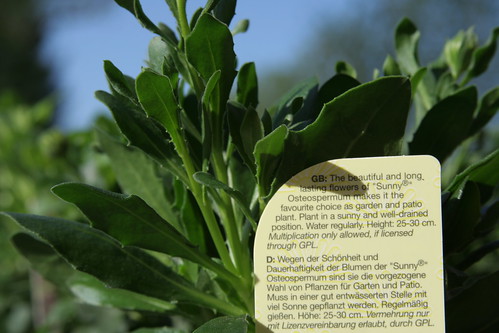
GPL is not always standing for the GNU General Public License… as this seen on a flower label. It's a company doing "plant novelty rights" called GPL international (http://www.gpl.dk/). They are clearly going into the opposite direction compared to the freedom defined in the well known free software license called GNU General Public License.
By the way, if those osteospermum flowers are not F1 hybrid we will be able to keep some good seeds and copy (doing multiplication) of the plant. It's the right to nature to reproduce itself. It's the first time I see a company trying to disallow the gardener (as described on their labels, check the photo below) the multiplication of the plant purchased.
Tags: freedom biology gpl gnu license nature gardening seeds biodiversity
2008-05-12 Wiki Creativity Metric An Experiment
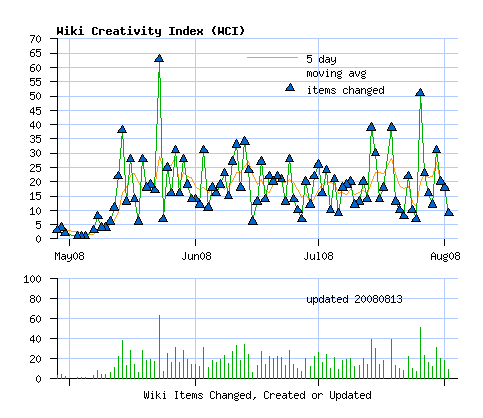
Following my past blog entry why creativity metrics are needed , I quickly made an experiment called Wiki Creativity Metric to monitor the activities of some well-known Wiki talking about Wiki (from technology to the use of them). The idea is to have a more positive approach to metrics where we can have more influence. Let's imagine that you have seen that the WCI was down yesterday, that's maybe the time to contribute more to CommunityWiki. If our world is overflowed with today's metrics, indices of all kind, why not inventing our metrics to make the world more free and better. I updated the graph following the excellent feedback from Jean-Etienne Poirrier.
Tags: metrics creativity positivism wiki freedom
2008-05-24 My Git To-Do Process
Until very recently, I was using a mixture of text files to maintain a to-do list across my various activities. The problem is some of my to-do and activities are linked and I needed a kind of permanent access to those lists while at work, home or travelling/moving. I also needed to update the list off-line and with the ability to merge them easily. That was working but not perfect and sometime messy.
I found an updated version of the famous todo.txt (a bash script to maintain plain text to-do list) called git-todo.py hosted at (gitorious.org). After a simple test, I decided to move all my to-do lists, idea lists or n lists to git-todo.py. The major work was to recreate all the lists using the simple format of todo.txt but that was straightforward.
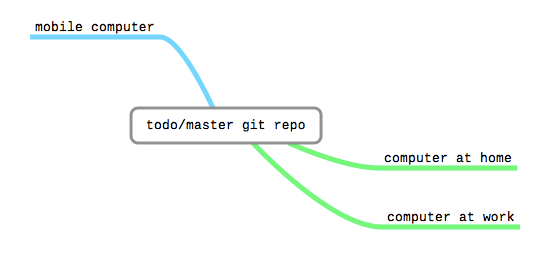
So I "centralized" (a big word for a distributed SCM ;-) everything around the to-do master git repository accessible via Internet, nothing really exotic. I have some basic script to always merge the master when I'm starting to work to be sure that the local branch is up to date.
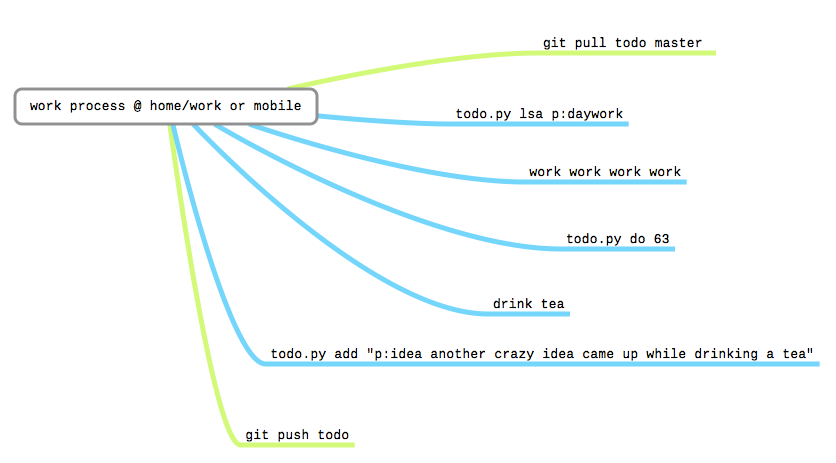
My daily process is roughly described in the diagram but the idea is there. I mixed all my various lists and used the format of todo.txt to tag the entries. That permits me to recover some old ideas lost in my previous messy format. Another big advantage of todo.txt is the ability to change child/parent for each entry. Very handy when you see that a project is going nowhere without making other tasks before.
I have also included the daily idea list where I'm just listing crazy idea coming in my mind or after discussions with a friend or a colleague. That's a way for me to keep a kind of imaginative playground along with more raw task to be done. When an idea is becoming a task (that's often a good news), I just add a tag to link the idea with the current project to work on.
![[FSF
Associate Member]](http://www.foo.be/fsfbutton-adulau.png)

