2007-09-02 Reorganising The Illusion of Progress
Reading the latest memo from an additional Yahoo! reorganization, I found the memo quite similar to other memos seen in various companies and not always in the same field…
The notorious and shared common blocks are the following :
- "
create better alignment with the core business units" - "
we are putting the right people in the right positions to focus on the right opportunities" - "
This move will drive further organizational alignment around our key audience properties" - "
developing holistic business strategies to delight and surprise these segments"
I saw in a comment containing a quote from Charlton Ogburn, Jr :
I was to learn later in life that, perhaps because we are so good at organising, we tend as a nation to meet any new situation by reorganising; and a wonderful method it can be for creating the illusion of progress while producing confusion, inefficiency and demoralization.
Yes, I know that's easy to take a quote. But I'm wondering why the wording when doing a reorganization in companies is always very similar and giving an impression to the reader that there is nothing new under the sun. It looks like when the approach of "reorganization" is taken is somehow a kind statement that we haven't found anything else to solve the problem. Maybe sometime a "reorganization" is giving a boost to a company due to the effect of moving the employee or operations… but moving the structure around the employee for just moving the structure. For sure, it will create a lot confusion and will probably increase inefficiency in the short and middle term. At least, I have some empirical example… I just think that company should not focus too much on their internal operation except if there are real impacts for the customers.
Tags: startup reorganization innovation entrepreneurship company
2007-09-10 Access To Information And Freedom
Today, I'm not feeling very well when reading the statement from Franco Frattini, the vice president of the European Commission :
"Donner des instructions pour fabriquer une bombe n'a rien à voir avec la liberté d'expression
et la liberté d'informer les gens, a expliqué M. Frattini. Le bon équilibre, à mon avis, est
de donner priorité aux droits absolus et au premier de tous, le droit à la vie."
and especially this comment from the AFP article :
Franco Frattini, le commissaire européen à la justice et à la sécurité, a annoncé lundi
10 septembre son intention de réfléchir aux moyens de limiter la recherche sur Internet de mots jugés "dangereux".
Reading between the lines, the right to education, information and freedom of expression is less important than security and "right to life". What's the hell ? Of course, you cannot be against the "right to life" but it's not by stopping access to information or education that would help. People really willing to hurt other don't need a lot of education. That's often the lack of education or information generating violence… The solution proposed by Mr. Frattini is to limit education. Curiosity is not a crime, it's the beginning of learning. How many chemist vocations started by the curiosity of explosive ? a lot. Please stop hurting education… and try to improve Europe as a free society not as a limited society.
2007-09-22 Audio Player And Free Software
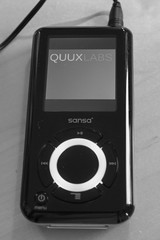 There is something I really don't like when I purchase a device… Being limited by virtual boundaries restricting the potential use for me of that device. Something made by the vendor just for his sole profit and not for the benefit of his customer. Apple is going more and more in that direction regarding their audio player devices (Apple locks free software). Why are all those audio player targeted to one specific "e-music" platform with those bloody DRM locks causing only trouble to legitimate users ? In such jungle, what is a good audio player ? Something flexible enough to install rockbox, a vendor respecting their customers and respecting the free software community. There are some but the hardware is often outdated or not anymore supported. Except for one vendor : sandisk gave hardware to the rockbox project. The negative point is they just gave hardware without documentation. So the rockbox guys made some reverse engineering… This is not perfect but looks at least better compared to the behavior of the other manufacturer. I purchased the sansa e280, I just hope that sandisk will work in the future to directly support the rockbox firmware.
2007-09-23 Open Access Is Vital
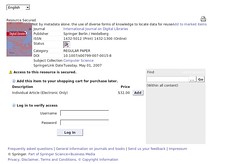 Looking at the critics about Open Access Critics of the various open access initiatives point out that there is little evidence that a significant amount of scientific literature is currently unavailable to those who would benefit from it. From Wikipedia/Open_access.
Looking for a specific article about meta data and archiving, I found one available via the restricted access of Springer for an impressive price. One of the major argument of publisher is to say that the access to some publication is only useful to a small amount of reader having the ability to pay for the article by them self or by their institution. Sorry but I would benefit from this article but $32 for a single article. The only benefit is for the publisher. Some years, the publishers were claiming that the electronic publication will lower the prices compared to printing… That's the opposite they limited the access to a very small subset of potential readers and increase the cost per article. Why ? Simply due to the global access given to the publishers to reach the "rich" readers only (with standard printing there were forced to reach a minimal number of users to cover their cost of printing/publication). Neither such practices it's an advantage for the author or the reader. An author without reader (or with a limited set) is not really useful especially in the scientific world. I'm still wondering why such publication about digital libraries are still published in that way and not using open access… Open access has the major advantage to give the access to a large set of potential readers and by so improving the interactivity between researchers/readers/authors.
Tags: reader publisher openaccess education innovation research
2007-09-27 Mediocre Software
Reading one of the latest excellent post from Paul Graham, I found this interesting part about the conservatism of large corporation when purchasing software :
There used to be a saying in the corporate world: "No one ever got fired for buying IBM." You no longer hear this about IBM specifically, but the idea is very much alive; there is a whole category of "enterprise" software companies that exist to take advantage of it. People buying technology for large organizations don't care if they pay a fortune for mediocre software. It's not their money. They just want to buy from a supplier who seems safe—a company with an established name, confident salesmen, impressive offices, and software that conforms to all the current fashions. Not necessarily a company that will deliver so much as one that, if they do let you down, will still seem to have been a prudent choice. So companies have evolved to fill that niche.
Reading between the line, if you run a startup and you have an excellent software that you want to sell to a large corporation. You'll need to do the following :
- Hire a nice and confident sales(wo)men,
- Spend money on a priceless office in the city center,
- Change the name of your company to something established or known (confusion is great),
- and… use buzzwords.
By doing so, you'll move your excellent software to just mediocre software chosen by large corporation (as you are not anymore focusing on the software but just its general packaging). A big dilemma…
![[FSF
Associate Member]](http://www.foo.be/fsfbutton-adulau.png)

